Friday, August 19, 2022

Hello, Fall 2022 students!

 Hello, you all. I look forward to meeting you soon. In the meantime, here is a list of supplies for the class "Intro to Illustration."

(owen gent)

REQUIRED MATERIALS

Note that these supplies are in addition to the base level requirements for a laptop with the Adobe Creative Suite (specifically Photoshop and Illustrator) OR a tablet with ProCreate.

11 x 15 watercolor sketch pad

Sketchbook (your choice)

Pencils 

Gouache (If you already have watercolor, you may use that. There are a number of possible alternatives that I am happy to discuss)

Watercolor palette

Brushes (#3 round, #6 round, 1/2" flat suggested.)

Brush pens

Black ink

Optional: Other working surfaces, like illustration board, other w/c paper. Other drawing tools of choice (colored pencil, markers)


Thursday, August 26, 2021

SUPPLY LIST!

 Hey beauts!


Lee Piechocki


Here is a supply list with links, so that you can fill in what you don't have. Let me know if you have questions about substitutions for any of these items. Note that these supplies are in addition to the base level requirements for a laptop with the Adobe Creative Suite (specifically Photoshop and Illustrator) OR a tablet with ProCreate.

11 x 15 watercolor sketch pad

Sketchbook (your choice)

Pencils (also your choice, but if starting from scratch this is a good set)

Gouache (I am linking to my preferred set, but if you already have some, or watercolor, there are a number of possible alternatives that I am happy to discuss)

Watercolor palette

Brushes (#3 round, #6 round, 1/2" flat suggested. This set works well)

Brush pen (this is my favorite, but there are many variations here as well)

Black ink

Optional: Other working surfaces, like illustration board, other w/c paper. Other drawing tools of choice (colored pencil, markers)

Monday, August 23, 2021

WELCOME, Students of Intro to Illustration, Fall 2021!

 If you scroll down, you will see that I have been keeping this blog for a number of years now. It's a place where I can keep tabs on certain ideas and illustrators and movements, and keep them accessible to new generations of aspiring illustrators like you. Feel very free to browse away, and do not be surprised at the possibility of dropped links, especially further back in time. The internet is like a proverbial river-- always on the move-- so if you see something that piques your interest with a broken link I can help you find your way to the good stuff. Looking forward to a semester of lots more finding and posting. Let's go!


Wednesday, September 12, 2018

Color as a psychological player in portraits

BB King by Sterling Hundley
Rachel Cusk by Siegfried Woldhek
Camelia Pham

Howard Fonda
Paula Moderson Becker
Frida Kahlo

Friday, September 7, 2018

Beginner's mind and the process of becoming an artist (a never-ending proposition)

Leah Tinari for Nike

Leah Tinari for Nike


Does an athlete become strong without doing reps and calisthenics?


Johnny Cash by Sterling Hundley


Does a musician stay on top of their craft without scales and exercises?


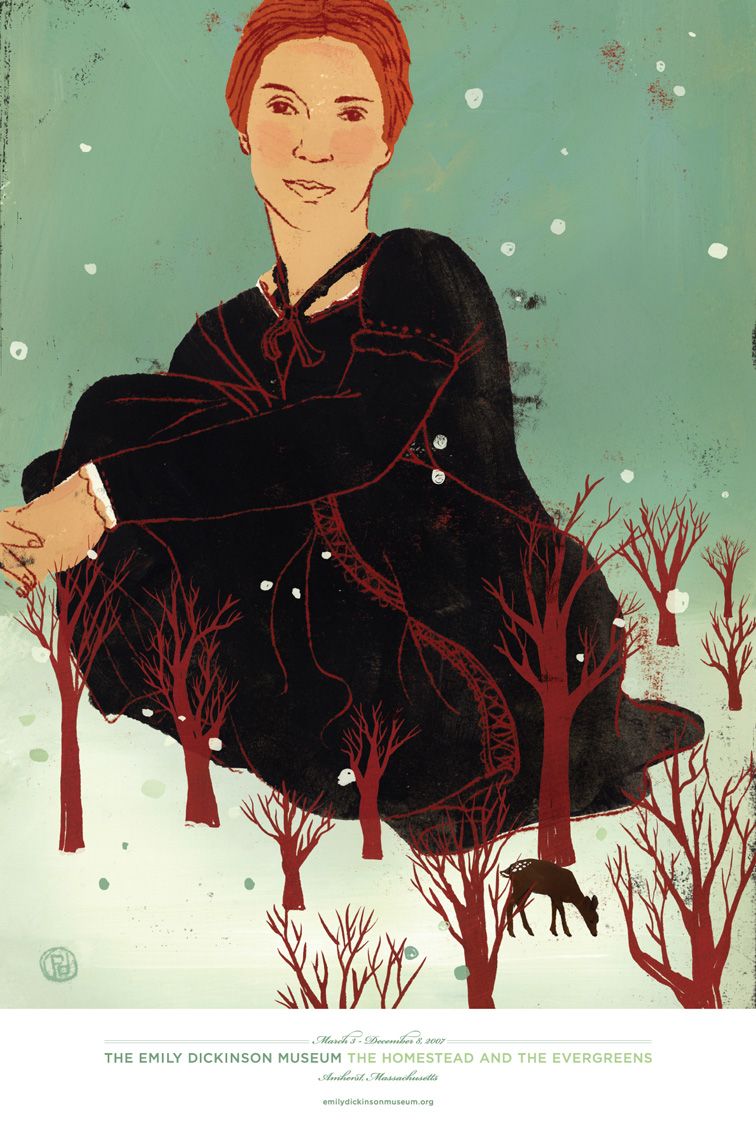
Emily Dickinson by Penelope Dullaghan
Does a writer become a great writer without writing every day, challenging their own edges, continuing to hone their skill and depth by returning again and again to the basics?

In a word, no. 

When you begin studies in any school setting, your sites are set on the final goal-- as they should be. As aspiring artists and designers and architects and film-makers, this means that you probably are ready to make amazing finished pieces, having been inspired by others who have made great work and having seen that your own hands and mind seem to have the capacity to do the same.

In a setting where you are learning the foundations of these skills, you may become impatient. You may long for greatness now.  And you should. But before you get ahead of yourself, realize that every practicing maker of note goes back to the basics ALL THE TIME in order to rebuild their chops. Every world-famous athlete still lifts weights (boring! but crucial!). If you take upon yourself this "beginner's mind" as you start your studies, you will gain so much from the process.

Certain exercises might seem below your level of expertise. Challenge yourself to find ways to make them interesting and deepening. Other exercises may seem to be beyond your scope or grasp. Enter into these with bravery and willingness to look foolish. Some things may interest you deeply-- run hard. Other things may be outside your natural inclinations-- press on. 

Your faculty are a team of caring individuals who also happen to be practicing artists. They are here to coach you into building a life-long practice of growth and development. We ourselves are constantly evolving, going back to the basics and reaching for new ground. Foundations never ends!

Charline Von Heyl


Thursday, August 30, 2018

Media Lab Welcome!

Hello, there! 

Jillian Tamaki
This is a blog that I allow to roll on over the years so that new students have the benefit of previous years of teaching and reference. The posts will presently be taken up with the task of showing first-year illustration students examples of work that relate to what they are doing in the course. Stay tuned, and enjoy this first batch of images thinking about the drawn/painted portrait:

Trenton Doyle Hancock
Alice Neel
Jean-Michel Basquiat

Julie Paschkis

Karen Kilimnik

George Condo


Tuesday, April 1, 2014

Hilma af Klint


From this article in the New York Times:
“Kandinsky was actively campaigning for himself as being the first abstract artist, constantly writing his gallery and saying, ‘Hey, you know, I was the first! I painted the first abstract painting in 1911!”’ said Julia Voss, an art historian and art critic for the German daily Frankfurter Allgemeine Zeitung. “He was obviously successful, as he’s widely considered the father of 20th-century abstraction. But all the while, af Klint, much more privately, had already been creating these striking, abstract visuals for years.”
In the March edition of the arts magazine Tate Etc., Ms. Voss campaigned on af Klint’s behalf, arguing that the Swedish artist, not Kandinsky, was the first abstract painter of the 20th century.
Georg Imdahl, a professor at the Academy of Fine Arts Münster in Germany and an art critic for the daily Süddeutsche Zeitung, is more hesitant on the matter. “She developed somehow outside the art scene of the time, so I think we need to learn more about her intentions as an artist,” Mr. Imdahl said. “That said, there are several of her works which I would consider integrating into a discussion of the genesis of 20th-century abstraction.”
The exhibition adds to the global debate about the canon of contemporary art. “In which box does this strange artist belong?” Ms. Müller-Westermann said of reactions to af Klint’s works. “Is she in the same box as Kandinsky and all the abstract pioneers, or maybe it’s easier to say it’s not art at all, just some woman who did something crazy?”
She continued, “The category does not interest me so much, to be honest; what intrigues me is simply to consider what is there. What did she see, what do we see?”


Fictitious interview that addresses some of the ways Hilma af Klint's work affects a contemporary audience.


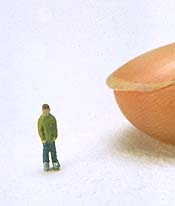
Wolfgang Laib


New York City, November 1986:

Klaus Ottmann: You studied medicine. How did you get into art?Wolfgang Laib: The more I knew about the natural sciences, the more I saw that they were too narrow for me and it’s just not what this body, what all these things are all about.
Ottmann: Did you ever think of going into something like holistic medicine?
Laib: No, because that would have been too small a step, and I tried to make a big step. It’s not about homeopathy or anything like that.
Ottmann: What kind of art did you start with?
Laib: I left university and half a year later I was already making my milkstones.
Ottmann: Where did you get the idea for the milkstones?
Laib: The milkstones are the direct answer to what I left, to what I found milk and stone are about. Because milk is not what is told in hygiene. You can teach everything about this liquid but have no idea of what it is.
Ottmann: When did you start working with pollen?
Laib: That came about two years later. This, of course, I would also have never done without studying medicine and avoiding an art college.
Ottmann: Tell me about your work process.
Laib: For years I had no studio at all. I collected my pollen from early spring to August/September, and then, in the late fall, I started to be very free, not being fixed to a space. So my studio was where I collected my pollen. Then, when I was doing more and more work, I bought a beautiful space, but it’s less of a studio and more like a space where I want to see my work in and be with it.
Ottmann: How long does it take you to collect pollen for one single piece?
Laib: It’s very different from one pollen to the next. Dandelion, for instance, has very little pollen and blossoms only for about four to six weeks. So I get only a small jar of dandelion pollen during one summer, and the piece is therefore very small. Pine has much more pollen, so I can make a large piece in the same time.
Ottmann: Do you collect the pollen just around where you live or do you collect also while you travel?
Laib: No, I always thought that would take away the concentration. It wouldn’t become more, so I collect only around my studio and the village where I live.
Ottmann: Does the pollen change with the time?
Laib: You have to be very careful because of the humidity, but I have pollen that is fifteen years old. For instance, with dandelion you have to be more careful, because it is very coarse, very organic. (excerpt from Journal of Contemporary Art. The rest of the interview can be found here.)

Monday, March 31, 2014

Tuesday, March 25, 2014

geo starts

Emma Kunz
Brent Wadden
Drew Shiflett
Serena Mitnik Miller

Louise Despont